
APEX EcoBuilt
Leading Manufacturer of Aluminum Systems & Modular Housing
APEX EcoBuilt
Leading Manufacturer of Aluminum Systems & Modular Housing
 24 Apr, 2026Knowledges
Specifying a curtain wall for the Middle East comes down to three non-negotiables: a deep polyamide thermal break (34 mm or more) paired with low-SHGC triple-silver coated glass, UV-stable peroxide-cured gaskets with labyrinth sand baffles at every joint, and a pressure-equalized drainage cavity sized for dust-laden wind-driven rain. Skip any one of these and you will see condensation, gasket chalking, or sand infiltration within the first five years — no matter how good the glass looks on day one.
Too many projects pick a curtain wall profile from a European catalog and assume it will perform in Riyadh. It will not. Dubai sees design temperatures of 48°C with 90% humidity spikes during the summer monsoon, while Riyadh hits 50°C dry-bulb with diurnal swings of 25°C that put thermal cycling stress on every sealant and fastener.
Before sizing anything, pull the ASHRAE 0.4% cooling design data for your specific site. Coastal projects in Doha or Abu Dhabi need higher humidity tolerance and salt-spray ratings (ISO 9227 minimum 1,000 hours). Inland projects in Riyadh or Muscat prioritize dust resistance and wider thermal breaks to handle the swing. A hotel on Saadiyat Island and a government tower in central Riyadh should not — and cannot — use the same facade spec.
Our manufacturing capabilities team typically asks for 10 data points before quoting: design temps, RH range, wind pressure from local code (SBC 301 in Saudi, UAE Fire & Life Safety Code), seismic zone, site dust loading category, and five more. Skip that step and you are gambling.
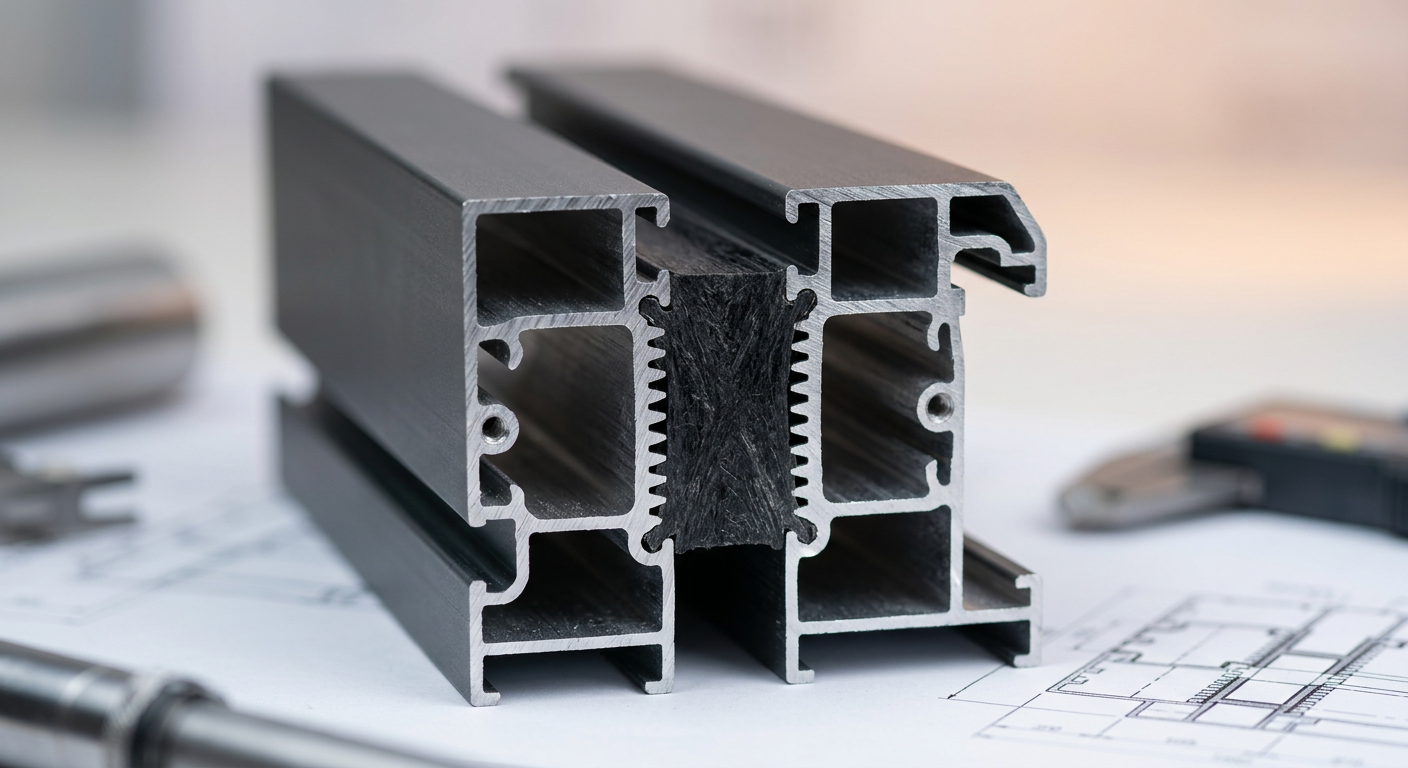
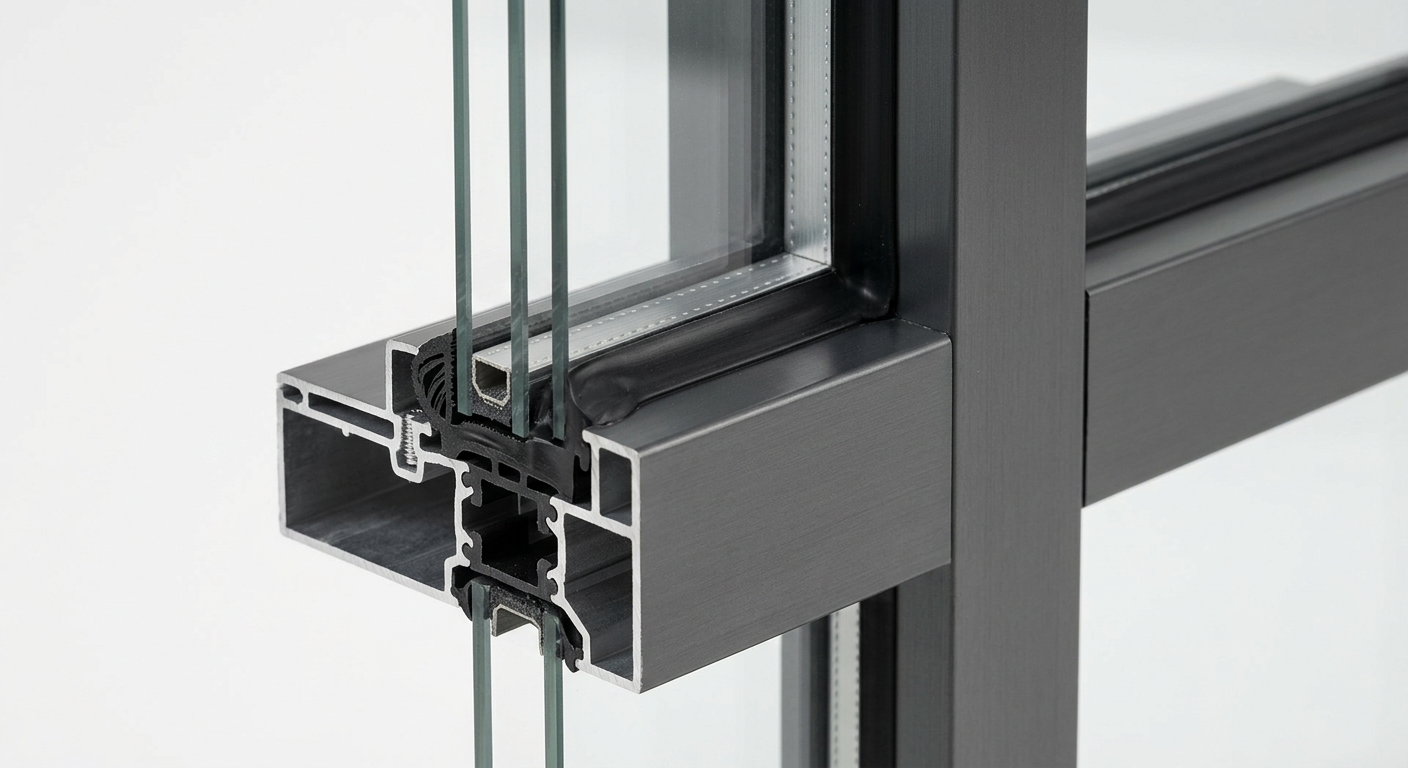
Aluminum conducts heat roughly 1,000 times faster than the polyamide strip inside a thermal break. In a 50°C Gulf summer, a 14 mm break lets enough heat through the mullion to raise interior aluminum surface temps to 34–36°C — warm enough that occupants near the facade feel radiant discomfort even with the AC running hard.
For Middle East projects we specify polyamide 6.6 GF25 thermal breaks no shallower than 34 mm, and 40–42 mm on west-facing elevations. Combined with a foam-filled cavity, this drops frame U-value from around 5.8 W/m²K (unbroken) to about 2.4 W/m²K. Pair that with double low-E glass and the system U-value lands near 1.4 W/m²K — meeting Estidama Pearl 2 and Saudi SBC 601 targets without exotic triple glazing.
Here is the counterintuitive part: condensation is a bigger problem in the Middle East than in Northern Europe. Interior set points of 21°C collide with 35°C dew points on humid coastal days. A marginal thermal break will sweat on the interior face every morning. We have seen Jeddah projects with chronic mold behind plasterboard reveals because the specifier chose a 24 mm break to save $40 per square meter.
In a cold climate, U-value dominates. In the Gulf, solar heat gain coefficient (SHGC) is the battle. Every 0.05 reduction in SHGC cuts roughly 40–60 W/m² of peak cooling load through the glass.
Target a whole-unit SHGC of 0.20 or lower for vision glass on east, south, and west exposures. That usually requires a triple-silver low-e coating on surface 2 of a double-glazed unit with a 12–16 mm argon cavity. Light-to-solar-gain ratio (LSG) should exceed 2.0 — otherwise the tower ends up looking like a mirrored bunker.
Sand-laden wind at 30 m/s behaves like low-grade sandblasting. Specify a 6 mm heat-strengthened laminated outer lite with 1.52 mm PVB. It resists surface pitting longer, handles thermal stress from partial shading, and meets post-breakage retention requirements under UAE code. Monolithic tempered outers pit visibly within 3–5 years on high-exposure elevations.
For example, a mixed-use developer in Muscat we worked with swapped their original monolithic outer for a 6.4 mm laminate after seeing pitting on a nearby reference project. Added cost: roughly 8%. Projected lifecycle savings from avoided re-glazing at year 10: considerably more.
Sand is the silent killer of curtain walls. It is not just abrasion — fine dust (PM10 and below) migrates into any gasket groove wider than 0.3 mm and holds moisture against the aluminum, accelerating pitting corrosion under the seal.
Horizontal stack joints and vertical splice joints need a labyrinth profile, not a straight gasket run. The tortuous path drops wind-driven dust out of the airstream before it reaches the drainage cavity. We mold baffle inserts directly into our gasket extrusions for unitized systems — it adds a few dollars per linear meter and eliminates the most common failure mode.
Here is something most specifiers miss: when it rains in the Gulf, it rains mud. Wind-driven rain carries suspended dust that settles and cakes inside the drainage cavity. Standard 6 mm weep holes clog in one season.
Spec oversized drainage slots (minimum 8 x 25 mm) protected by an internal baffle that lets water out but blocks dust from entering. The pressure-equalization cavity should be sized with at least 20% more volume than equivalent European spec to handle the rapid pressure swings during shamal events — sustained winds of 40–50 km/h with gusts above 80 km/h.
Test performance to AAMA 501 or EN 12154 with the dynamic water penetration test at minimum 600 Pa. For coastal high-rises, push that to 900 Pa. And insist the mock-up includes a dust-loading phase before water testing — it changes the result.
For any project over 8 stories or 5,000 m² of facade in the Middle East, go unitized. The logic is simple.
Site labor productivity in extreme heat drops 30–50% between May and September. OSHA-equivalent heat stress protocols in Saudi Arabia now mandate midday work stoppages from 12:00 to 15:00 during summer months. Stick-built curtain wall, which relies on extensive on-site assembly, becomes a schedule and quality nightmare. Sealants cure incorrectly at 45°C ambient. Workers rush. Rework compounds.
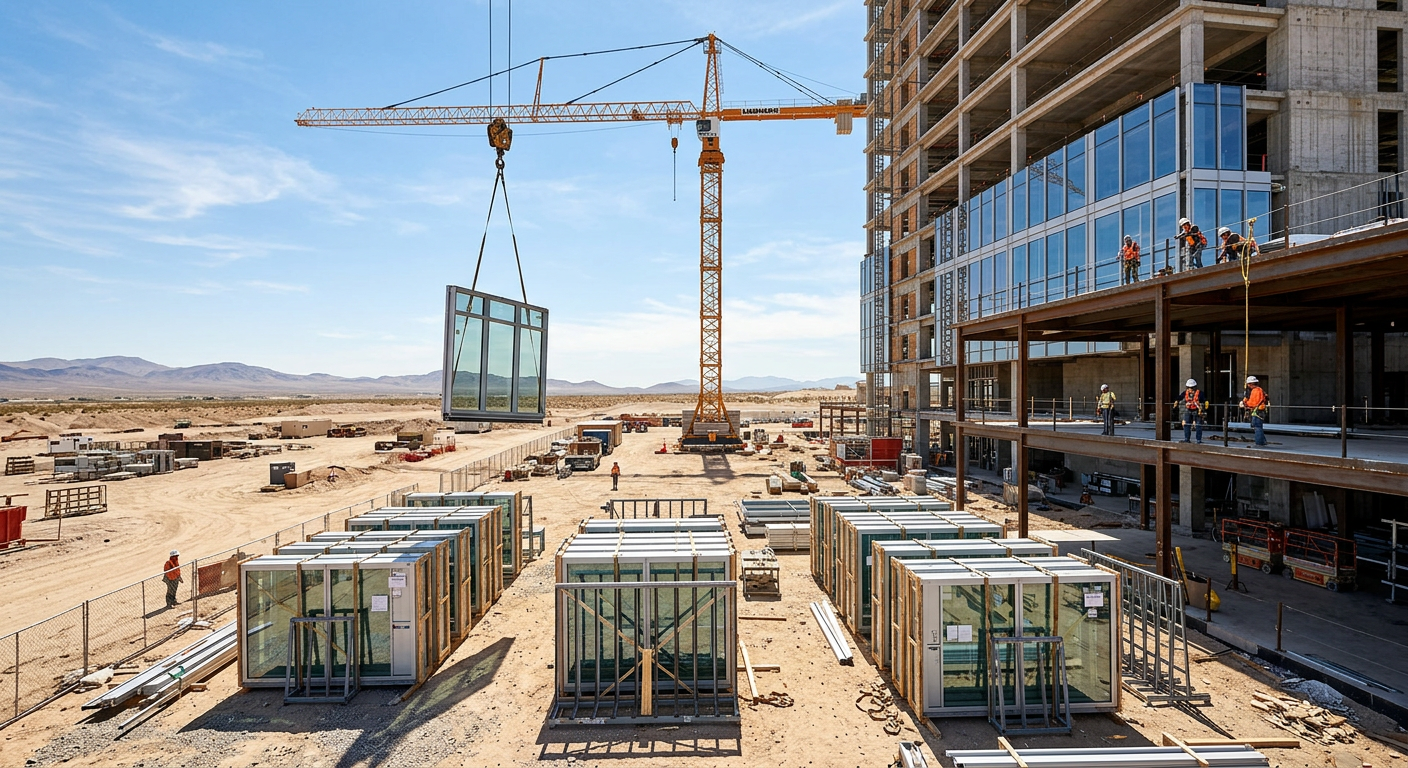
Unitized panels arrive glazed, gasketed, and factory-tested. Installation becomes a lifting and clipping operation — crews can install 80–120 m² per day even with heat restrictions. Factory QC at our 150,000 m² plant catches sealant and glazing defects before panels ship, under controlled 23°C / 50% RH conditions.
For example, a Poly Group residential tower we supplied in Doha switched from stick to unitized mid-design. The facade critical path shrank by 14 weeks, and factory-applied structural silicone cured under controlled conditions instead of on a 42°C balcony. See similar case examples under projects.
UV exposure in the Gulf is brutal. Radiation intensity peaks above 1,050 W/m² at noon in June. Standard 25 µm PVDF coatings fade visibly within 7–10 years, especially on saturated reds, blues, and dark bronzes.
For Middle East exteriors, specify a two-coat PVDF system at 70 µm total dry film thickness (primer + topcoat) using Kynar 500 or Hylar 5000 resin at 70% minimum. This is what delivers the 20-year color retention warranty. Anything thinner is a false economy.
Light colors reflect more solar radiation — a white or silver frame runs 15–20°C cooler than a dark bronze frame in direct sun. That temperature difference translates directly into thermal cycling stress on the sealant bond line. If the architect insists on dark frames (and they often do), compensate with deeper thermal breaks, reinforced anchor brackets, and silicone rather than polysulfide weather seals.
Do not accept any curtain wall package for a Middle East project without these tests documented on the project-specific mock-up, not just generic manufacturer data:
Local compliance adds another layer: Saudi SASO, UAE Civil Defense fire safety (NAS3:2018 for facade combustibility), Estidama in Abu Dhabi, and LEED or Mostadam credit targets. ISO 9001, ISO 14001, and CE marking on the manufacturing side are baseline expectations, not differentiators.
If you take one thing from this guide, make it this: the Middle East curtain wall spec is a system, not a collection of parts. The thermal break, glass, gasket, drainage, and finish decisions all interact. Upgrade one in isolation and you often shift the failure mode somewhere else.
A defensible baseline spec for a commercial tower in the Gulf looks something like this: unitized aluminum system, 42 mm polyamide thermal break, double-glazed triple-silver low-e vision glass at SHGC 0.22 and U-value 1.4 W/m²K, 6.4 mm heat-strengthened laminated outer lite, peroxide-cured EPDM primary gaskets, two-part silicone structural sealant, 8×25 mm baffled drainage, two-coat 70 µm PVDF finish. From there, tune for elevation, altitude, proximity to coast, and specific code targets.
If you are scoping a project in the GCC, the Levant, or North Africa and want help pressure-testing your facade spec before it goes to tender, our engineering team has delivered curtain wall into 80+ countries and can review your basis of design against regional performance data. Start a conversation through contact us, or browse regional reference work under solutions and applications.




Arabic

English

Spanish
Fill out the form below and our team will get back to you within 24 hours with a tailored solution.
