
APEX EcoBuilt
Leading Manufacturer of Aluminum Systems & Modular Housing
APEX EcoBuilt
Leading Manufacturer of Aluminum Systems & Modular Housing

 27 Jul, 2026Company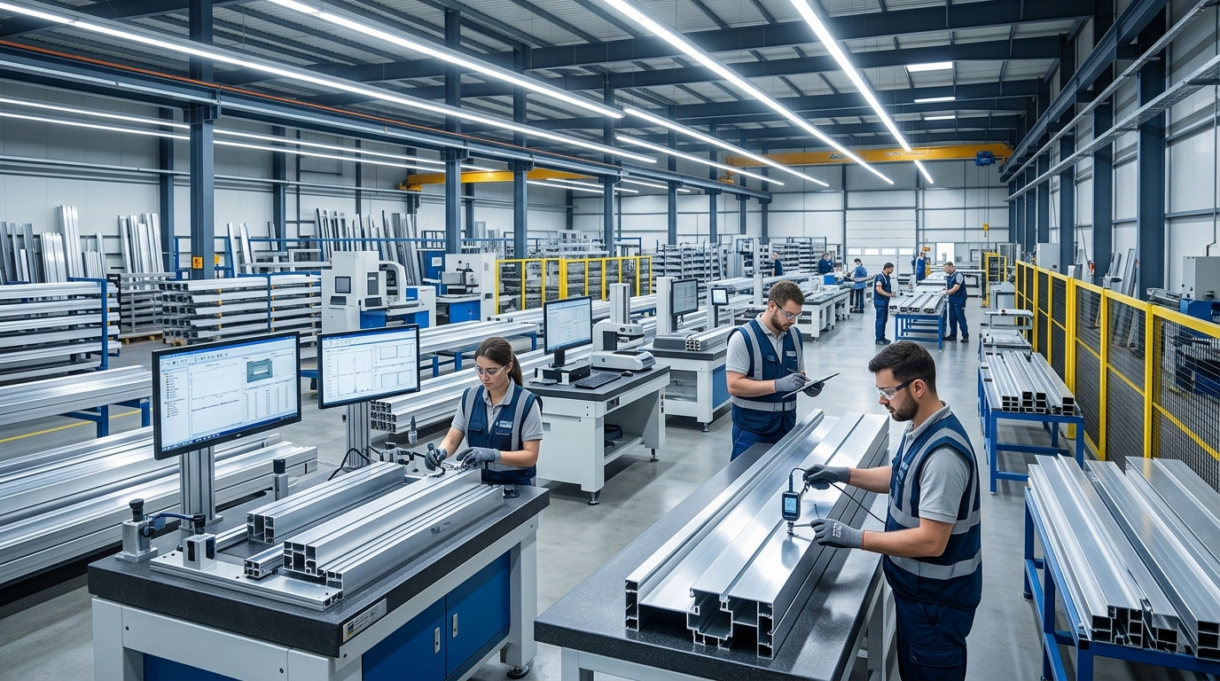
Apex Eco Built’s 179+ patents aren’t trophies on a wall — they’re embedded in the tooling, inspection methods, and process controls that produce every aluminum profile, curtain wall unit, and modular structure leaving our 150,000 m² factory. The result: tighter extrusion tolerances (±0.08 mm on critical profiles vs. the ±0.20 mm industry norm), thicker and more consistent anodized films, and thermal-break assemblies that pass 3,000+ hour salt spray testing. Here’s how that translates into systems your project can actually rely on.
Most buyers assume patents mean novel product designs. In aluminum manufacturing, the real value lives in process patents — and that’s where the bulk of ours sit.
Roughly two-thirds of our portfolio covers manufacturing methods: die-cooling techniques that reduce dimensional drift, anodizing bath chemistry tweaks that produce more uniform films, thermal-break injection sequences that eliminate void formation. The remaining third covers structural innovations — interlocking unitized curtain wall joints, modular corner connections, and hardware geometries that improve air and water tightness.
Why does this distinction matter? Because a product patent benefits one SKU. A process patent benefits everything that runs through that process. When we patent a smarter way to quench an extrusion, every profile downstream gets straighter. That compounding effect is the real engine behind consistent quality at scale — something we explore further in our manufacturing capabilities overview.
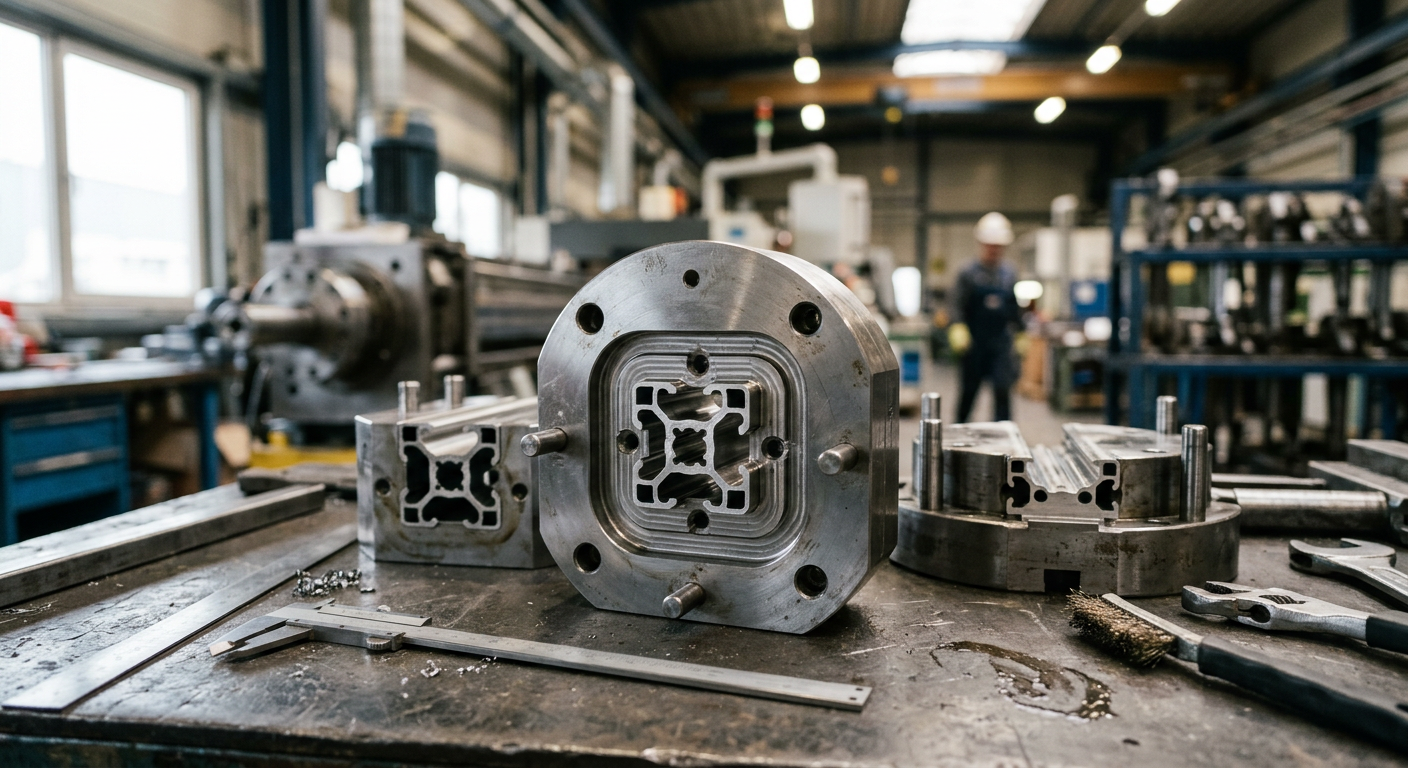
Quality isn’t a final inspection. It’s five separate gates, each with its own pass/fail criteria.
Every 6063-T5 or 6061-T6 billet is spectro-tested for alloy composition before it touches a press. We reject anything outside ±0.05% on magnesium and silicon — the two elements that most affect extrudability and final strength.
Profiles are laser-measured at three points along their length within 30 seconds of exiting the press. Out-of-tolerance sections get flagged before the metal cools and locks in the defect.
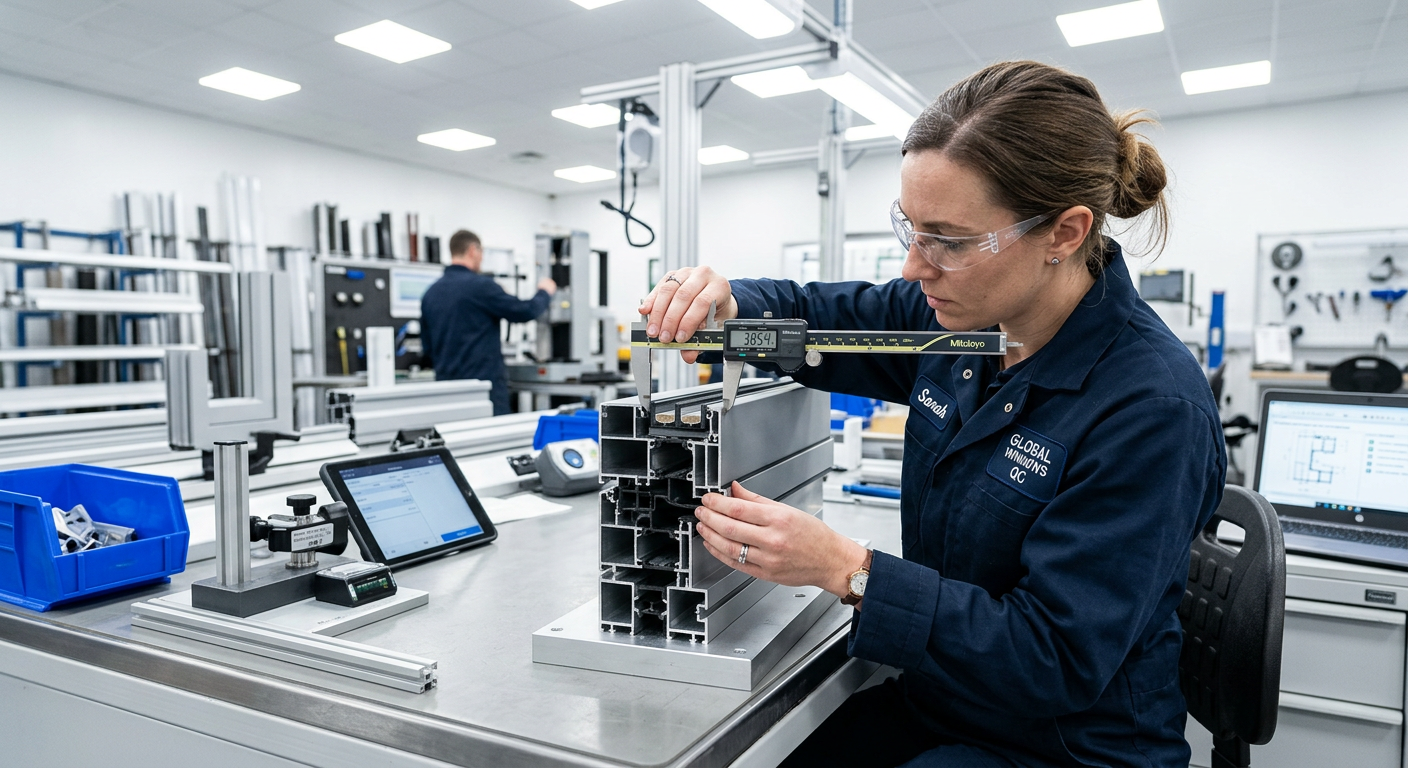
Anodized film thickness is measured at five points per profile using eddy-current gauges. Powder coatings are checked for film build, gloss, and adhesion (cross-hatch tape test).
Polyamide strips are shear-tested per lot. We reject if shear strength falls below 24 N/mm — well above the EN 14024 minimum of 24 N/mm at room temperature.
A random 5% of every order is pulled for full re-inspection. If two units fail, the entire lot is re-checked.
A 0.1 mm deviation sounds trivial. On a 40-story unitized curtain wall, it isn’t.
Stack 60 floors of unitized panels and a consistent 0.15 mm vertical drift per joint becomes 9 mm of cumulative misalignment by the top — enough to ruin gasket compression and let water past. Our patented die-cooling process holds critical vertical mullion straightness within 0.5 mm per 6 m length, roughly half the industry standard of 1.0 mm.
For a real-world contrast: a Middle East developer working with us on a 180 m tower found that tighter mullion tolerances cut their on-site shimming labor by about 40% versus a previous supplier. That’s not a marketing number — that’s a project manager comparing two timesheets. For projects in harsh climates specifically, see our breakdown on spec’ing curtain walls for Middle East conditions.
Two anodized profiles can look identical and perform totally differently. The variable is film thickness and seal quality.
The AAMA 611 spec defines three architectural classes: Class II (10 μm minimum) for interior or mild exterior use, and Class I (18 μm minimum) for harsh exteriors. Many low-cost suppliers quote “anodized” without specifying the class — and deliver 8–12 μm films that chalk within five years in coastal or desert environments.
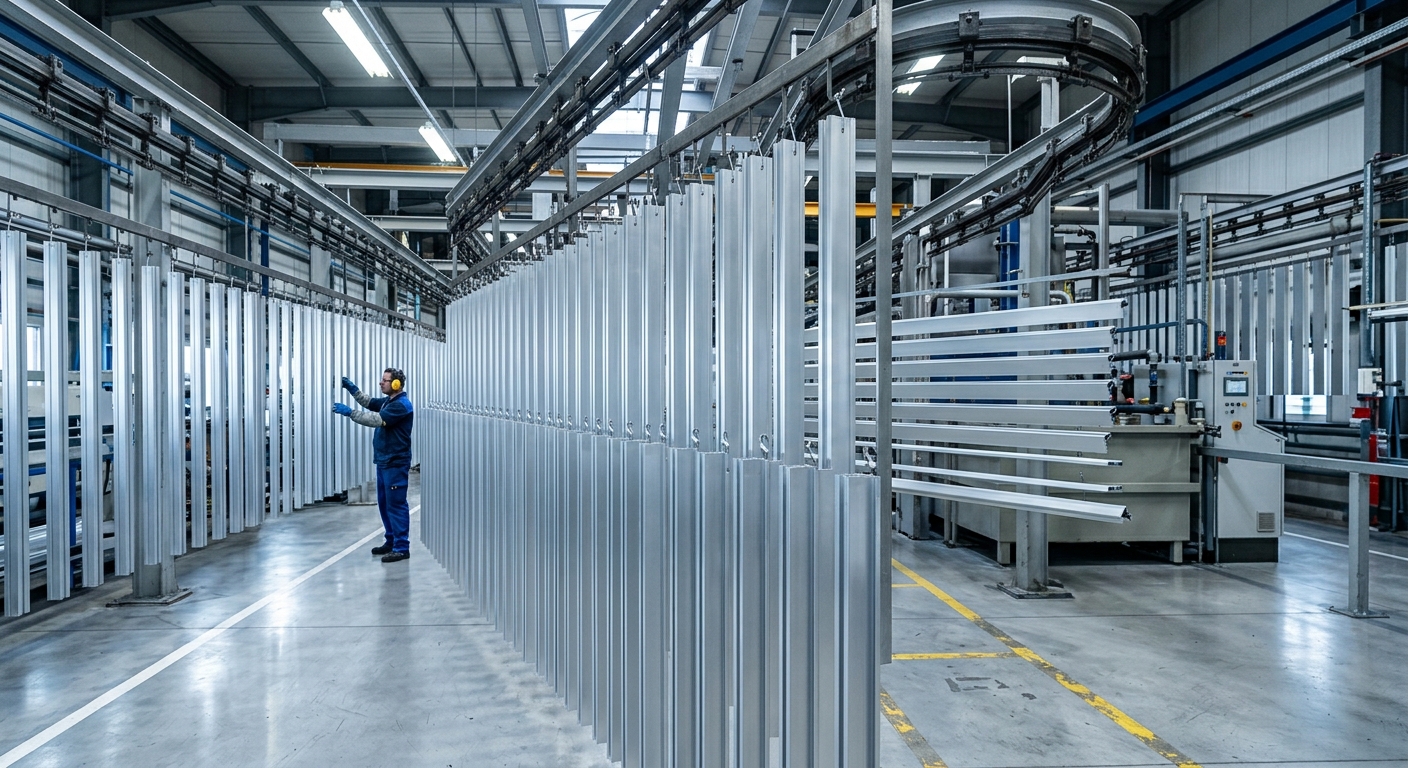
Our standard is 15 μm for indoor systems and 20–25 μm verified for coastal, desert, and high-UV projects. On powder coating, we run AAMA 2605-class fluoropolymer (PVDF) systems that survive 3,000+ hours of salt spray and 10+ years of South Florida exposure with under 5 ΔE color shift. The patent here? A pretreatment chromate-free conversion process that improves coating adhesion by 20% over standard methods — and is also REACH-compliant.
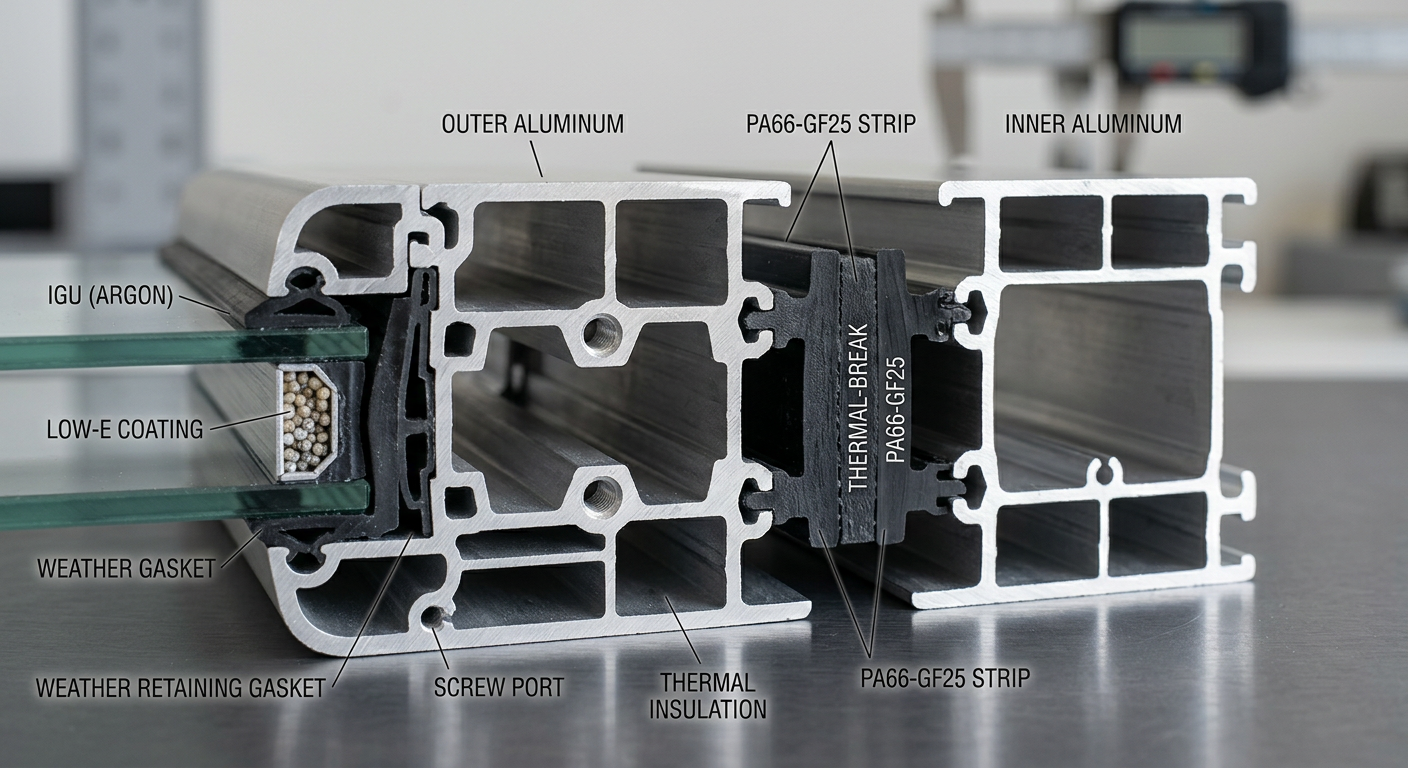
The polyamide strip between your inner and outer aluminum profiles is the single most failure-prone component in a thermal curtain wall. Get it wrong and your U-value collapses by 30–50%.
Three things typically go wrong: voids in the rolling process, shear strength loss at elevated temperatures, and moisture absorption that swells the polyamide and stresses the aluminum channel. Our patented dual-roller crimping process applies pressure in two stages instead of one, eliminating the micro-voids that cause cold spots and condensation streaks.
We also run a Sabin-Heat-cycle test (-40°C to +80°C, 100 cycles) on every new project’s thermal break assembly before mass production. For a Nordic hotel chain we supplied last year, this caught a polyamide batch that met room-temperature shear specs but lost 18% strength at -30°C — exactly the conditions their site would see. Catching it pre-production avoided a multi-million-dollar facade callback.
For modular structures, patents shift from extrusion tooling to connection geometry and waterproofing details.
Two examples: a patented eight-point corner casting that distributes stack loads more evenly across multi-story modular buildings (allowing us to ship pre-finished six-stack modules with no in-field reinforcement), and a labyrinth-style inter-module gasket joint that achieves Class 4 wind-driven rain performance per EN 12865 — without any wet sealant on site.
The QC implications are real. Because the connections are mechanically interlocked and dimensionally tight, our installation crews and clients don’t depend on caulking quality to keep buildings watertight. For remote-site operators — think mining camps in Mongolia or oilfield housing in the UAE — that’s the difference between a five-year service life and a fifteen-year one. Explore the full modular solutions range for sector-specific configurations.
Every profile leaving our factory carries a laser-etched ID linking it back to billet lot, press run, operator, surface treatment batch, and final inspector. It takes 30 seconds to look up; it can save a project six figures.
Here’s why: when a facade contractor reports a coating defect three years post-install, generic suppliers shrug and offer a token replacement. With profile-level traceability, we can pinpoint exactly which batch was involved, check whether other shipments from the same lot are at risk, and offer surgical remediation instead of guessing.
This is also where our ISO 9001 and ISO 14001 systems do real work. Auditors don’t just check that we have procedures — they verify that the digital records match the physical product on the shelf. Every quarter. Without warning.
If you’re writing a tender or vetting a supplier, here are the four QC clauses that separate genuine quality from box-checked marketing claims:
Suppliers that can answer all four without scrambling are the ones worth shortlisting. For broader sourcing pitfalls, our piece on modular vs. traditional construction trade-offs covers some of the same ground from a sustainability lens.
The quickest way to evaluate any aluminum supplier is to ask for a recent factory audit report and a sample inspection record from a comparable project. If they hesitate, you have your answer. If they hand it over with line-item detail, you’ve likely found a partner worth specifying.
At Apex Eco Built, the 179+ patents, the five QC gates, and the ISO-certified traceability stack aren’t a sales pitch — they’re how we keep delivering to developers, contractors, and public-project owners across 80+ countries without the callbacks and warranty fights that plague this industry. If you’re sizing up a curtain wall or modular package and want to see what genuine QC documentation looks like, get in touch with our engineering team or browse our current project case studies for reference.


Arabic

English

Spanish
Fill out the form below and our team will get back to you within 24 hours with a tailored solution.
