
APEX EcoBuilt
Leading Manufacturer of Aluminum Systems & Modular Housing
APEX EcoBuilt
Leading Manufacturer of Aluminum Systems & Modular Housing
 28 May, 2026Knowledges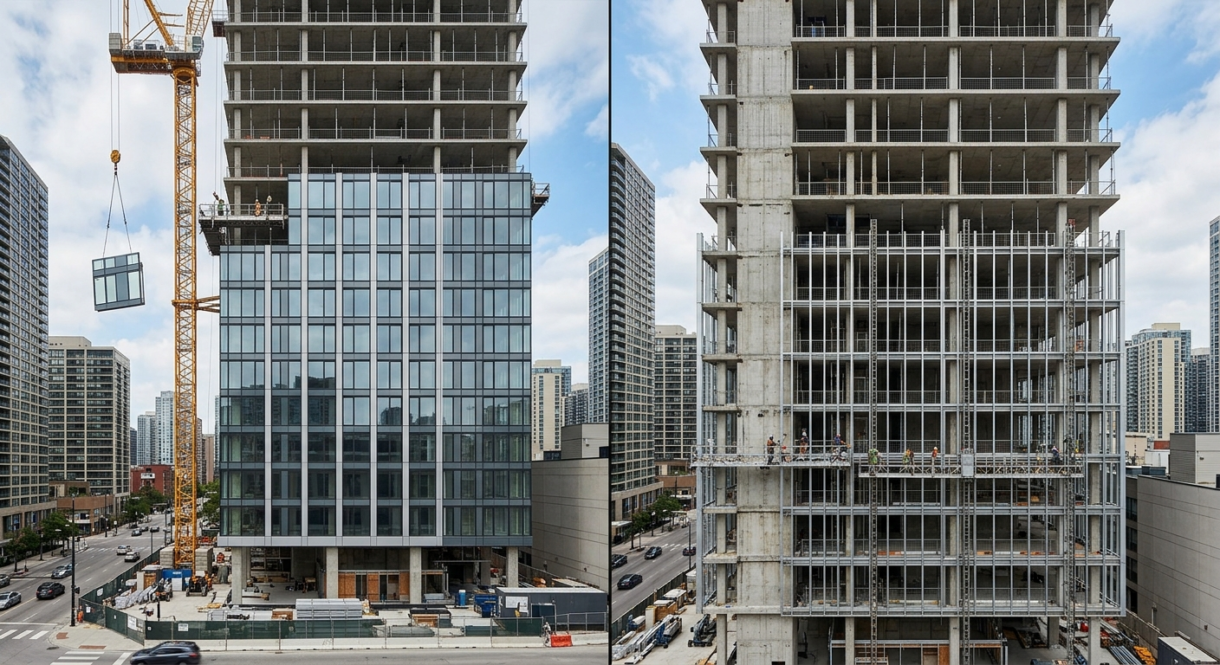
If your project is six stories or taller, on a tight schedule, or in a city where labor is expensive, unitized curtain walls almost always win. If you’re building low-rise, have an irregular facade, or need to keep upfront material costs down, stick-built is the smarter call. The two systems aren’t really competitors — they solve different problems, and picking the wrong one can blow up your budget by 20–30% or push your handover date out by months.
The names give it away. Unitized curtain walls are assembled in a factory as large pre-glazed panels — usually one floor tall and one bay wide — then shipped to site and hoisted into place. Stick-built systems arrive as raw extrusions, gaskets, and glass that get assembled piece by piece on the building itself.
That single decision — factory vs. field — cascades into everything else: how long you wait, what crew you need, how the building performs in a storm, and how much you write a check for at the end.
Here’s the part nobody tells first-time buyers: a unitized panel typically costs 15–25% more in materials than the equivalent stick-built area. But it can cut on-site labor by 60% and shave weeks off your enclosure schedule. So the question isn’t “which is cheaper?” It’s “where does your project bleed money — materials or time?”
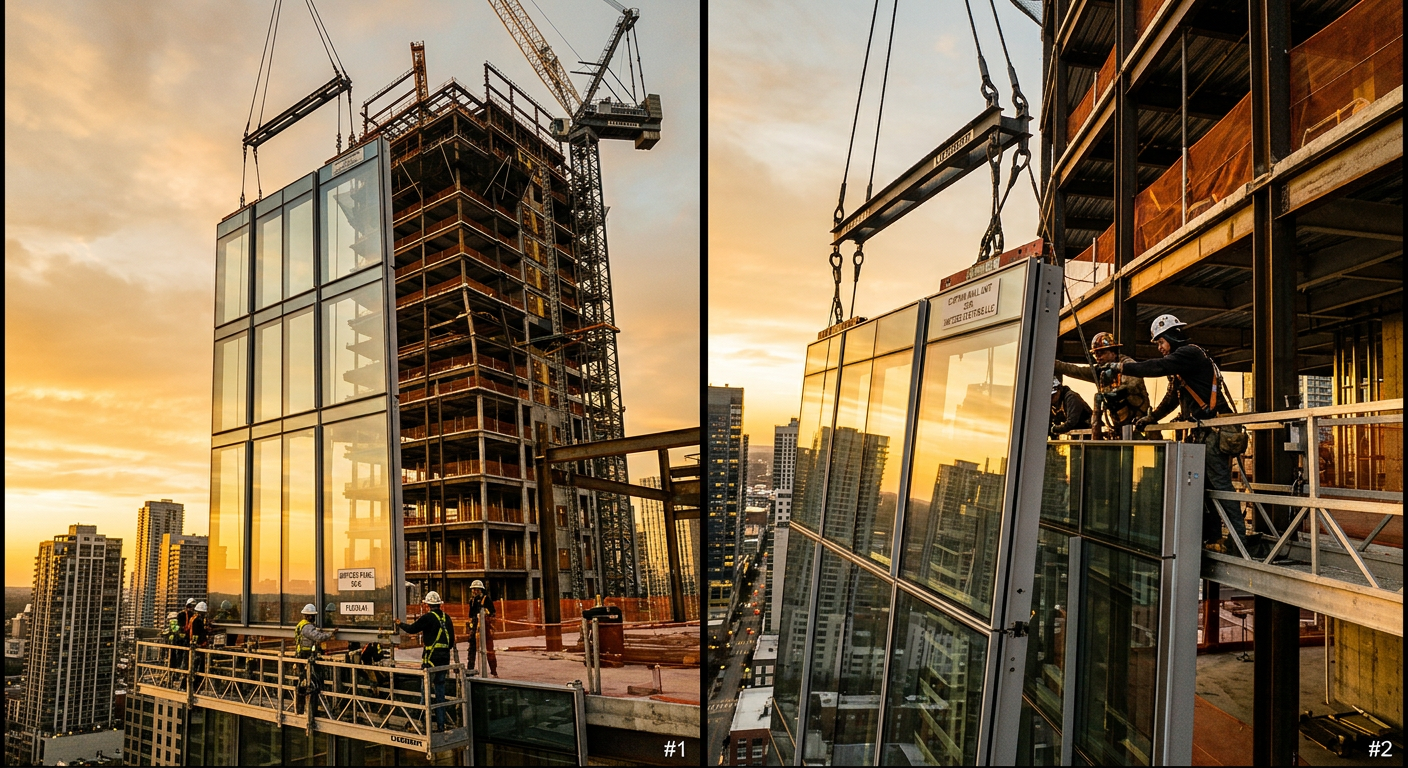
Unitized is the default choice for high-rise commercial towers, hotels above 10 floors, and any project where the facade is on the critical path. Why? Three reasons.
A trained crew can hoist 20–30 unitized panels per day — that’s roughly 400–600 m² of facade per week, depending on panel size. Stick-built rarely exceeds 250 m². On a 30,000 m² tower, that gap alone can mean 4–6 months of schedule difference.
When silicone is applied in a 22°C climate-controlled bay instead of a windy scaffold at floor 28, you get consistent seals, accurate tolerances (±1 mm vs ±3–5 mm in the field), and far fewer water-test failures during commissioning.
Stick-built installation halts during rain, high wind, or freezing temperatures. Unitized panels go up in almost any condition because the weatherproofing is already done. For projects in monsoon climates or Northern Europe winters, that alone justifies the premium.
For a concrete example: a developer building a 24-story hotel in Dubai chose unitized panels precisely because the summer heat was shutting down stick-built crews by 11 a.m. They cut facade installation from a projected 14 months down to 7. If you’re spec’ing for hot or sandy environments, our guide on curtain wall design for Middle East climates goes deeper into thermal break and sand-loading details.
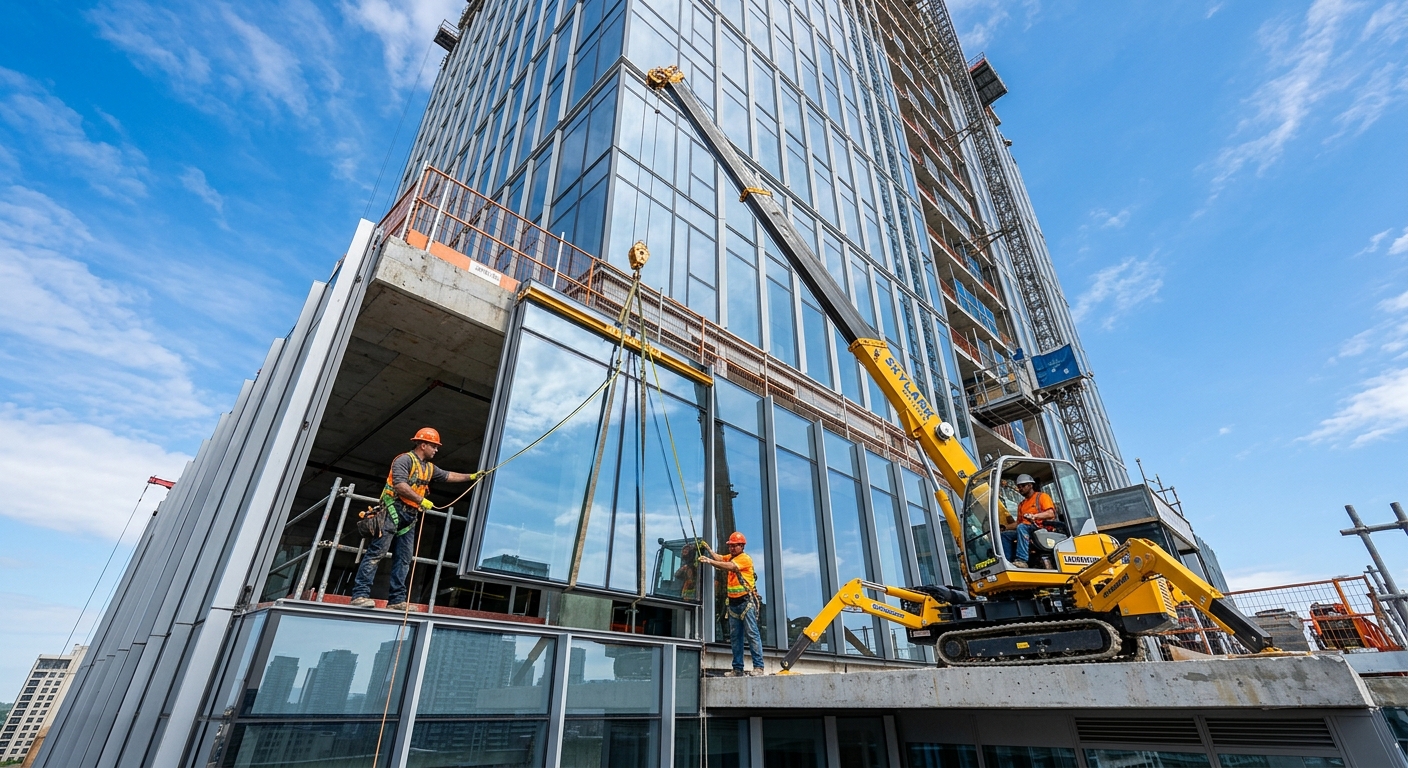
Stick-built isn’t the obsolete cousin some marketing makes it out to be. For the right project, it’s genuinely the better engineering choice.
The speed advantage of unitized evaporates when there are only two or three floors of facade. Crane logistics, transport costs, and panel sizing overhead start to outweigh the labor savings. A 3-story office building or a boutique hotel is almost always more economical in stick-built.
Got a building with non-rectangular geometry, mixed materials, or a custom artistic facade? Stick-built handles complexity better because every joint is field-adjustable. Unitized requires repetitive panel modules to be cost-effective — every custom panel adds a tooling charge.
Some contractors and developers simply can’t absorb the higher unitized material cost upfront, even if total project cost is similar. Stick-built spreads the spend across a longer install window, which can ease cash flow on smaller projects.
A real example: a regional contractor in Southeast Asia building four-story school campuses across remote sites stuck with stick-built. Why? No reliable crane access at most sites, repetitive small facades, and a local labor force already trained on stick assembly. Unitized would have made everything harder.
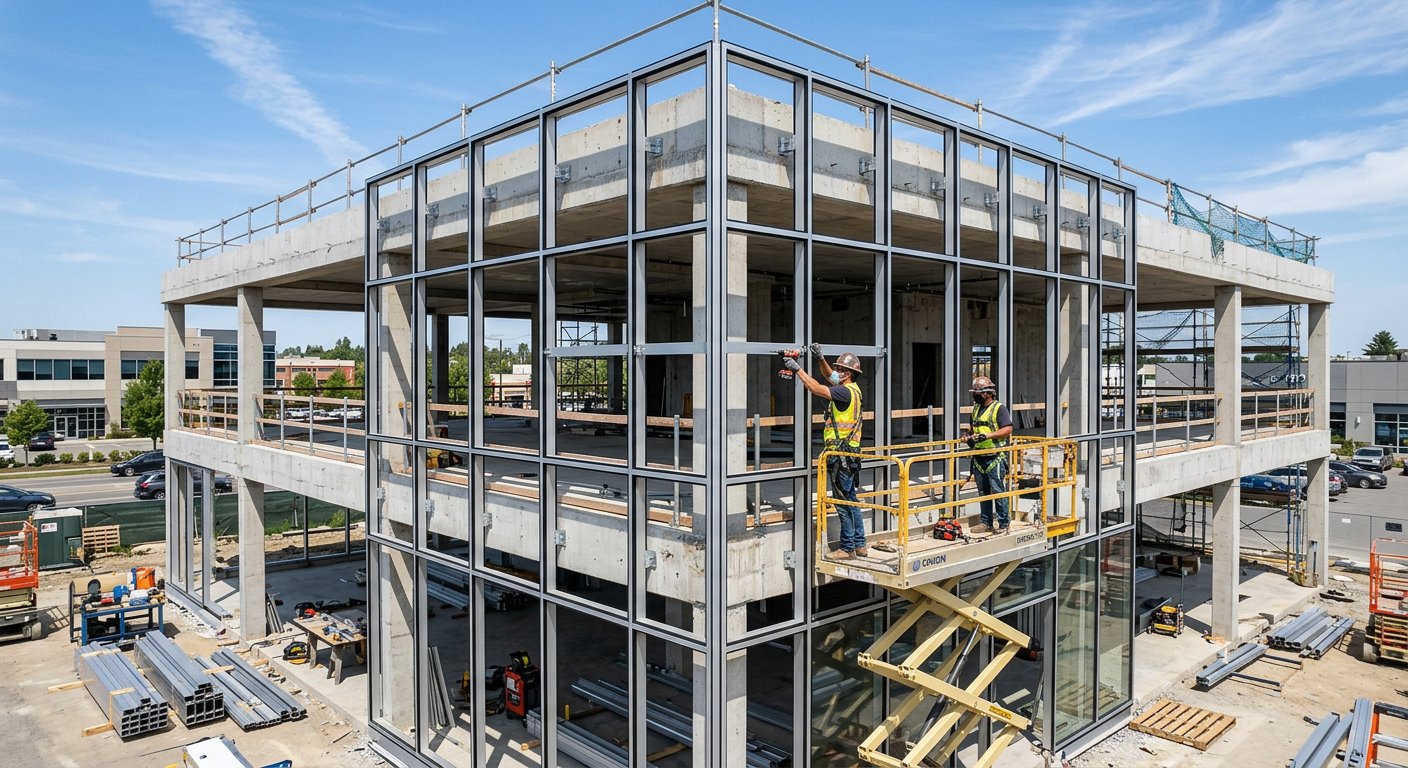
Here’s the cheat sheet. Pin this somewhere when you’re scoping your next project:
| Criteria | Unitized | Stick-Built |
|---|---|---|
| Best Building Height | 6+ stories / high-rise | Low-rise / 1–5 stories |
| Material Cost (per m²) | 15–25% higher | Lower base cost |
| Installation Speed | 400–600 m² per week | 150–250 m² per week |
| On-Site Labor Required | Low — small crew | High — skilled crew |
| Quality Control | Factory-controlled ✓ | Field-dependent |
| Weather Sensitivity | Minimal impact | Major delays possible |
| Design Flexibility on Site | Low — locked at factory | High — adjustable |
| Lead Time | 10–16 weeks | 4–8 weeks |
One thing this table can’t show: total installed cost is often within 5% between the two systems on mid-rise projects. The real differentiator is schedule risk. If your loan structure or pre-sale obligations punish late delivery, unitized is cheap insurance.
Most procurement spreadsheets compare panels per square meter and stop there. That’s how projects end up over budget.
Unitized panels need cranes — sometimes dedicated tower cranes scheduled around the rest of the build. On urban sites with strict lift-window permits, this can add weeks of coordination. Stick-built rolls up on a regular truck.
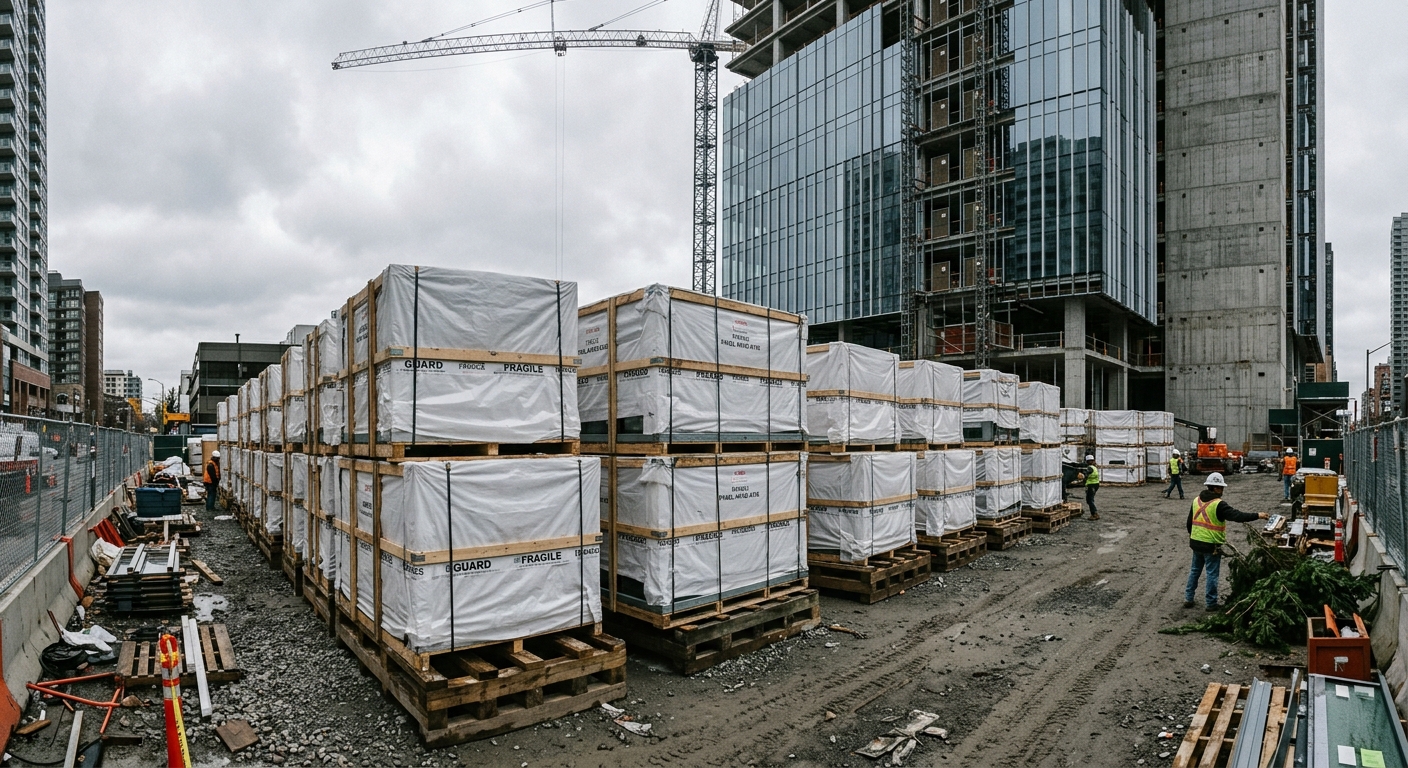
Each unitized panel arrives with glass already attached. They need protected, weather-shielded staging — usually 1.5–2x the panel footprint. Tight urban sites sometimes can’t accommodate this without paying for off-site warehousing.
If a unitized panel gets damaged in transit or during install, replacement takes weeks because it has to be re-fabricated. Stick-built components are commodity — a broken extrusion or pane gets swapped same day from local stock.
For high-rise unitized projects, performance mock-ups (PMU) and visual mock-ups are usually mandatory. Budget USD 30,000–80,000 for testing alone. Stick-built often skips this on smaller projects.
Bottom line: get a quote that includes shipping, crane time, mock-ups, and a contingency for replacement panels — not just the per-square-meter facade rate.
Spec sheets often look similar — both can hit the same U-values, air infiltration ratings, and water test pressures on paper. But real-world performance diverges in two ways.
Unitized panels use stack joint and split mullion designs that drain water through pressure-equalized chambers. When fabricated in a controlled environment, they consistently pass AAMA 501.1 dynamic water tests at higher pressures. Stick-built can match these numbers — but only with disciplined site supervision and repeated field testing.
Stick-built systems often have continuous metal-to-metal pathways at transom-to-mullion joints, creating subtle thermal bridges that erode the rated U-value by 10–15% in real conditions. Unitized panels with factory-installed thermal breaks tend to deliver closer to their rated performance. For a deeper look at why this matters, check the solutions page or our notes on energy performance.
Unitized panels handle inter-story drift better — each panel moves independently at the stack joint. For projects in seismic zones (Japan, Chile, parts of California, Türkiye), this is a meaningful safety and longevity advantage.
Lead time is where buyers get blindsided. A unitized order isn’t just “wait 12 weeks.” It’s a sequence: design coordination (2–3 weeks), shop drawings approval (3–4 weeks), material procurement (2–4 weeks), fabrication (4–6 weeks), and shipping (2–6 weeks depending on destination).
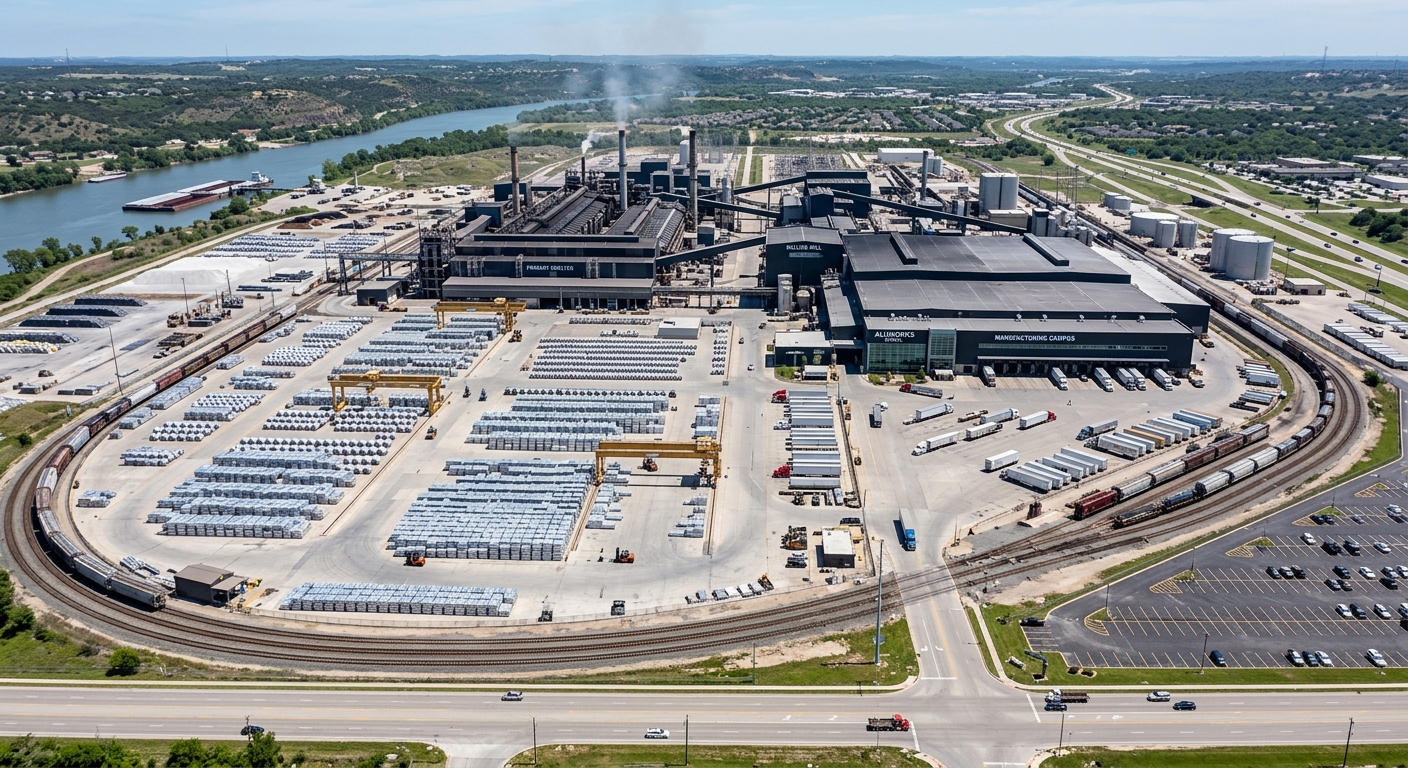
If your supplier doesn’t have in-house glass processing, anodizing, and assembly under one roof, expect those numbers to stretch. This is exactly why scale matters. Our 150,000 m² facility handles extrusion, anodizing, glass, thermal break insertion, and panel assembly in one location — which is what allows us to compress unitized lead times to 10–12 weeks for standard configurations.
Stick-built lead times are shorter (4–8 weeks) because there’s less factory work — but you pay for it in field installation duration. The total “design start to weather-tight” timeline often favors unitized despite the longer lead.
Practical advice: lock in your facade supplier during schematic design, not after construction starts. The shop-drawing iteration phase is where most projects lose 4–6 weeks unnecessarily.
Run through these five questions before you commit:
For hybrid projects — say, a low-rise podium with a high-rise tower above — it’s perfectly normal to use stick-built on the podium and unitized on the tower. Mixing systems within one project is increasingly common and often the smartest spec.
Browse our completed projects to see how different building types have used each system, or compare against our broader modular vs. traditional construction comparison if you’re also weighing structural approaches.
The right answer isn’t unitized or stick-built — it’s the system that matches your building height, schedule, site conditions, and risk profile. Get those four factors right and the cost question usually answers itself. Get them wrong and you’ll fight your facade for the rest of the project.
If you’re scoping a curtain wall package and want a straight answer on which system fits — including a transparent cost breakdown that includes shipping, mock-ups, and crane time — talk to our engineering team. We’ll review your drawings, climate, and timeline and recommend the system that actually saves you money, not just the one with the bigger margin. You can also explore our curtain wall product range to see standard configurations available for both systems.




Arabic

English

Spanish
Fill out the form below and our team will get back to you within 24 hours with a tailored solution.
