
APEX EcoBuilt
Leading Manufacturer of Aluminum Systems & Modular Housing
APEX EcoBuilt
Leading Manufacturer of Aluminum Systems & Modular Housing
 05 Sep, 2026Knowledges
By the APEX EcoBuilt Engineering Team — specialists in BIM/FEA-based structural simulation for aluminum building systems.
Aluminum extrusions are metal profiles formed by pushing heated aluminum through a shaped die, producing a continuous length with a fixed cross-section. The process turns a solid billet into anything from a small T-slot bar to a large architectural mullion, and it's the manufacturing method behind most aluminum framing, structural, and facade components on the market today.
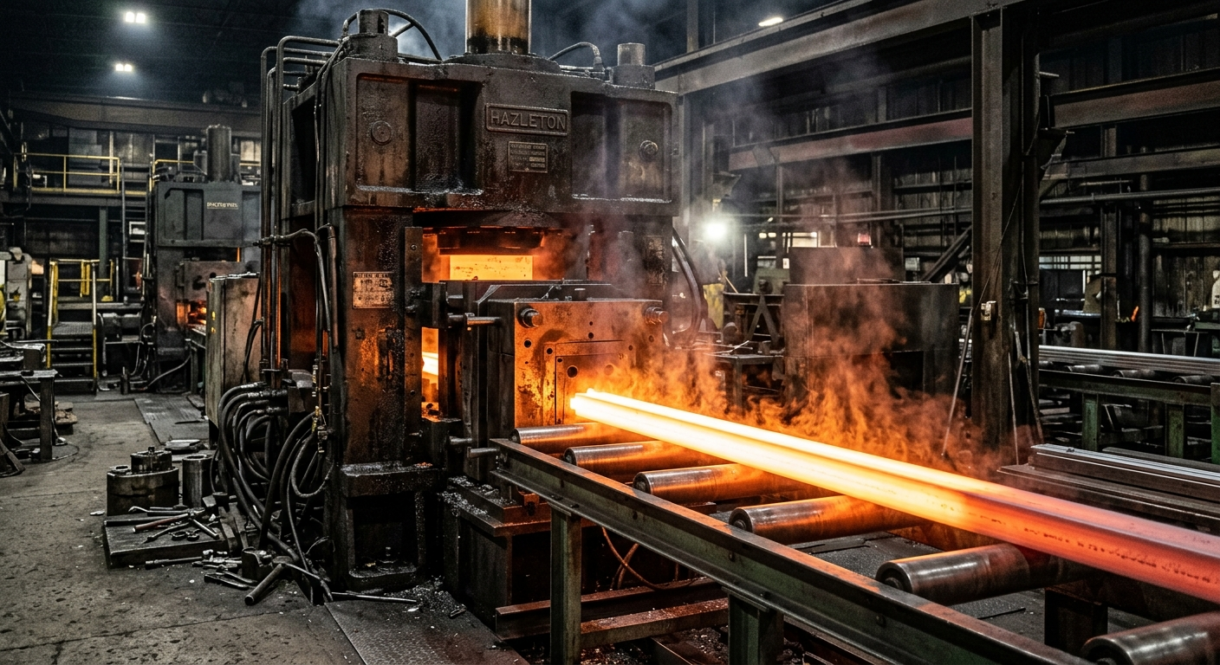
Aluminum extrusion is a manufacturing process, not a product line. A cylindrical billet of aluminum is heated until pliable, then forced through a hardened steel die under high pressure. Whatever shape is cut into the die — a channel, a tube, a T-slot, a complex multi-cavity mullion — becomes the shape of the aluminum coming out the other side. The die is what separates a stock T-slot bar from a custom architectural profile: same process, different tooling.
Billets are heated to roughly 800–925°F before pressing — hot enough to flow under pressure but not molten. Press tonnage for architectural profiles typically runs 1,500–5,000 tons, and extrusion speed falls between 3–15 feet per minute, with softer alloys like 6063 running faster than higher-strength 6061. After exiting the die, the extrusion is air- or water-cooled, then stretched and straightened to correct twist, cut to length, and aged or heat-treated to reach final strength.
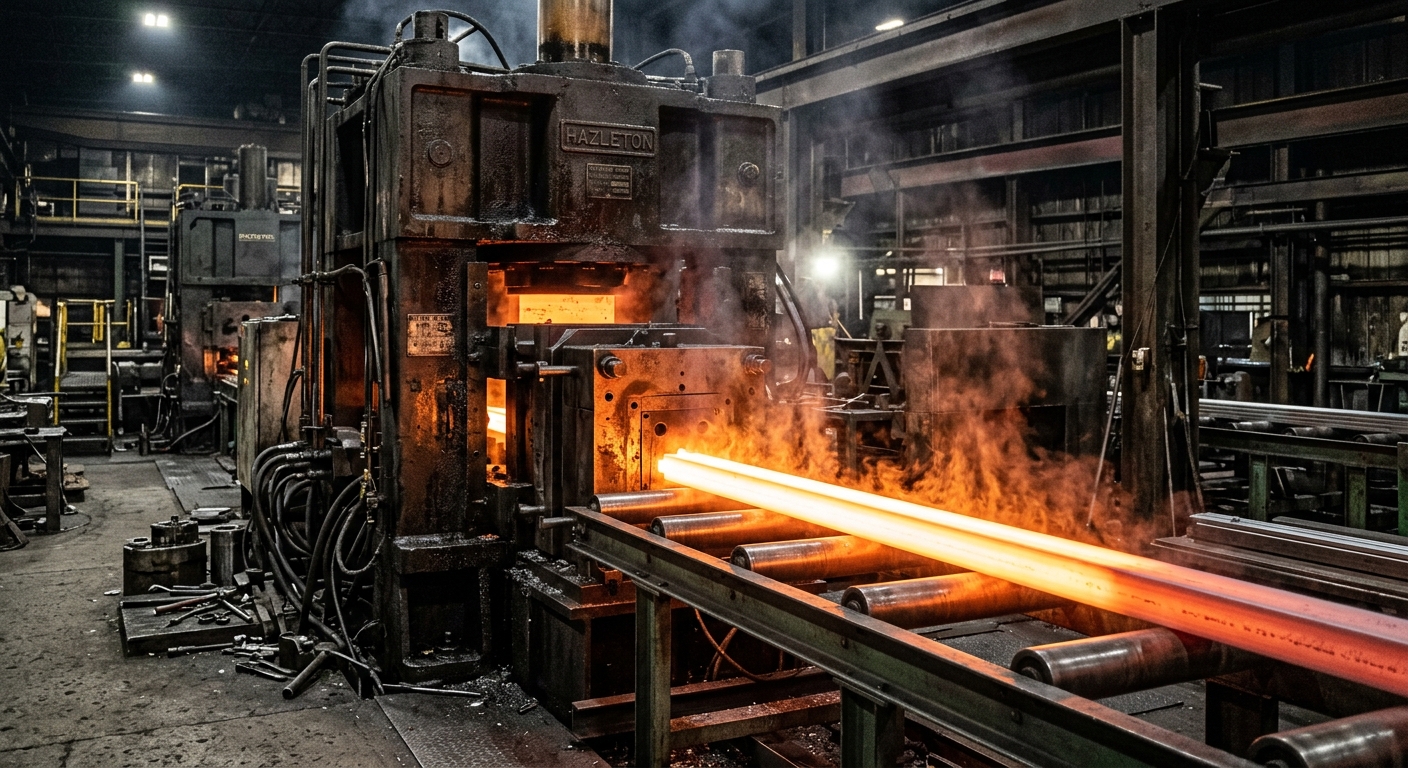
Aluminum extrusions sizes are limited by the press circle and the die; the ranges below are what most architectural work falls into.
Profiles fall into three broad families: T-slot framing bars with integrated slots for T-nuts, structural stock — tubes, channels, and angles — and custom architectural profiles such as mullions, transoms, and cladding trim engineered for a specific building skin rather than pulled from a catalog.
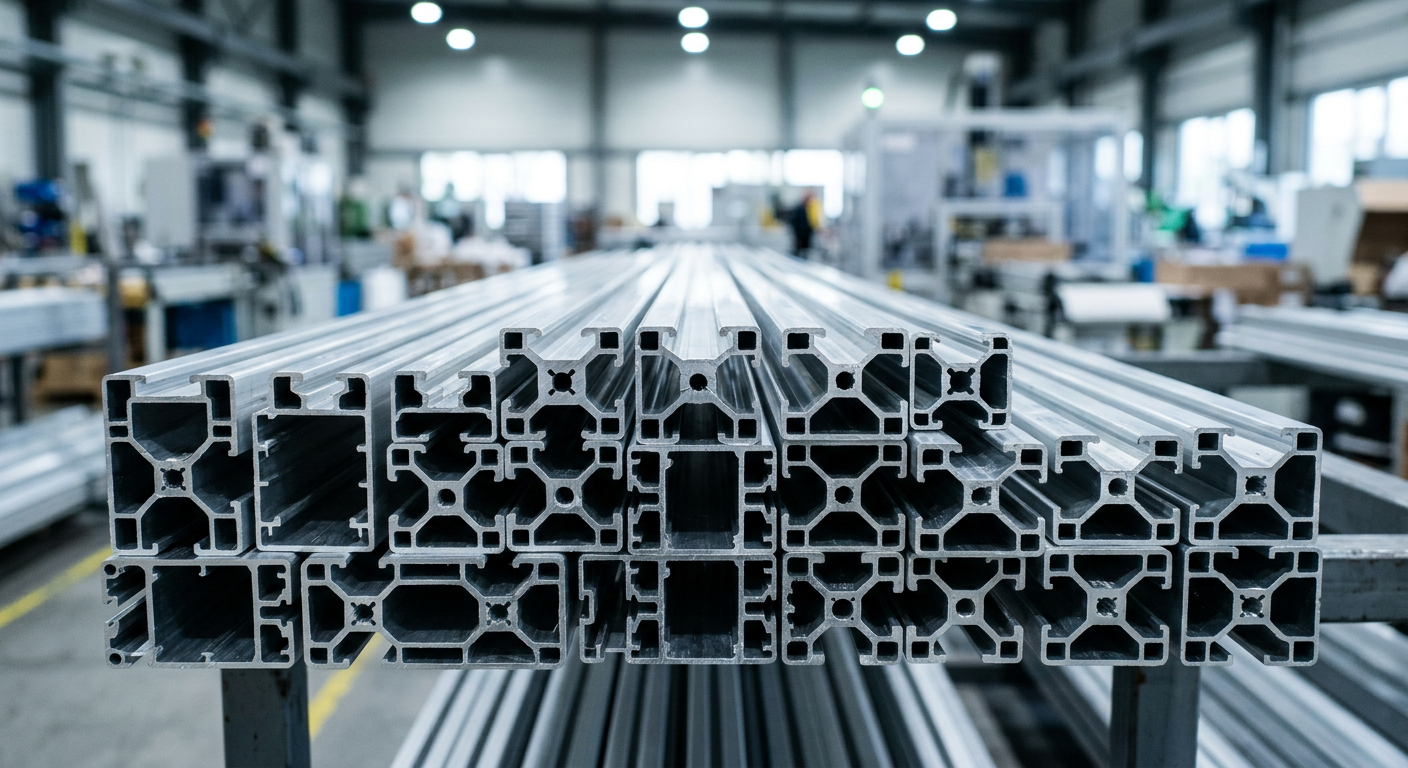
Press circle sizes across the industry range from about 7 inches up to 20+ inches in diameter for large custom sections, but a bigger circle demands more tonnage and a slower ram, so oversized profiles cost more and run slower than standard sizes. 6063-T5 is the common choice for architectural profiles because it extrudes cleanly and finishes well; 6061-T6 is favored where higher structural strength matters. See 6061 vs 6063 Aluminum: What to Spec for when to use each.
ASTM B221 sets the industry's dimensional tolerances, and they vary by dimension — a wall under 1" might hold ±0.004", while a larger cross-section widens to ±0.01" or more. Thin-wall profiles can stack tolerance across multiple walls, so a complex multi-cavity shape accumulates more total deviation than a simple bar of the same nominal size.
Extrusion isn't limitation-free. Die lines — faint striations running the length of a profile from die wear and lubrication — are managed with anodizing or coating, not eliminated. A high tongue ratio (a fin's protruding length versus its thickness) gets harder to fill evenly as it climbs, which caps how thin and long a decorative or interlocking leg can run before short-fill or die distortion becomes a risk. High-strength 7xxx alloys resist metal flow at extrusion temperature, so they're rarely used for extruded architectural shapes despite outperforming 6xxx alloys in raw strength. Most suppliers also set a minimum order weight per die run — commonly 500–2,000 lb — since re-tooling the press below that volume isn't economical.
Two failure patterns show up repeatedly when extruded mullions and transoms are modeled under real building loads: stress concentration at fillet radii where a thin wall meets a thicker structural leg, and torsional flex in open (non-tubular) cross-sections under wind load — which appears as glazing pocket distortion rather than outright breakage. BIM-linked FEA simulation lets engineers test a die design against wind, thermal, and seismic loads before steel is ever cut, catching an undersized wall or an overly deep tongue that would otherwise only surface after installation.
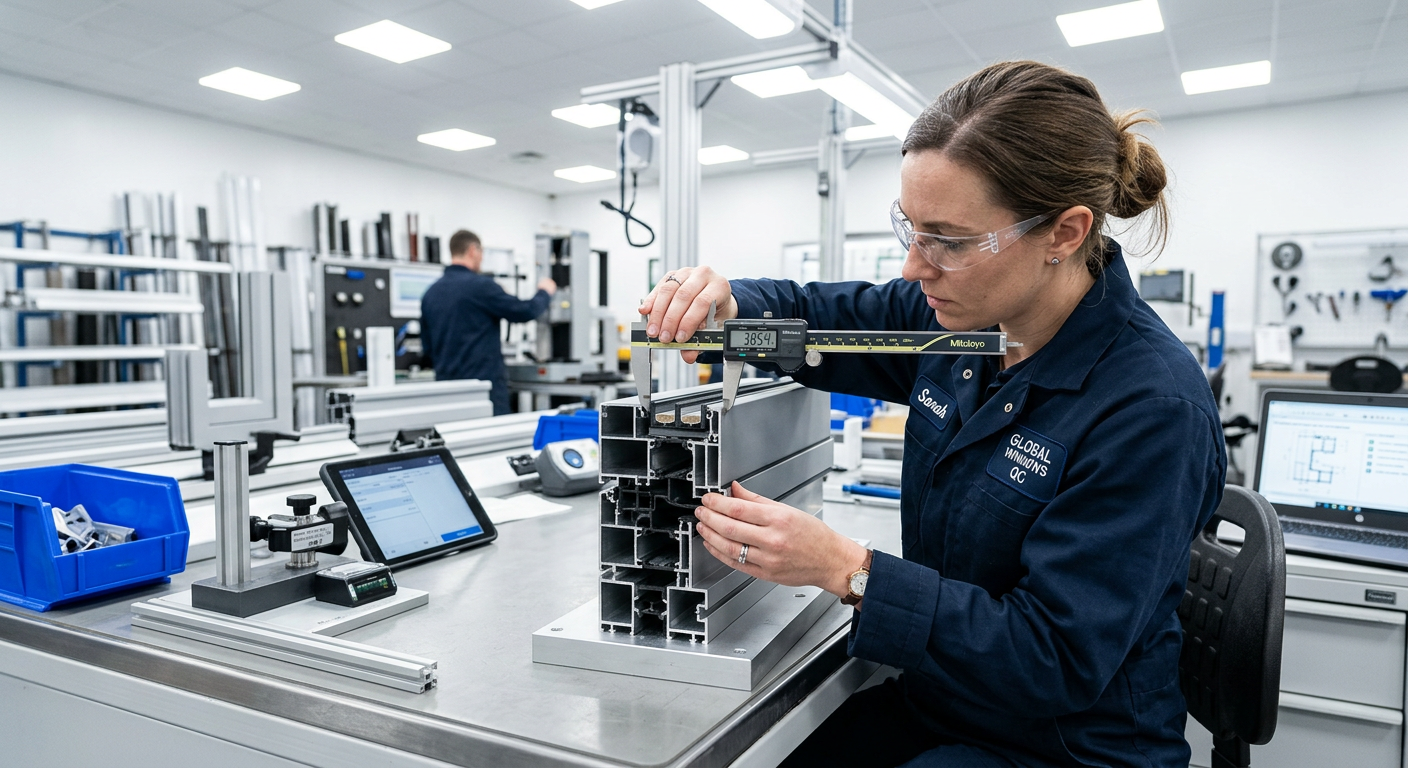
Standard profiles come from dies already sitting in a supplier's library, making them cheaper and faster to ship since tooling is already paid off. Custom profiles need a new die cut to a buyer's exact cross-section — the right call once a project needs a shape no catalog carries, like a proprietary curtain wall mullion or a non-stock dimension.
Hollow dies, needed for tubular profiles, commonly cost 2–3 times more to build than solid-profile dies, and that gap carries into piece price at low volume. Aluminum Extrusions Cost: Prices & What Affects Them breaks down how die type, alloy, and order volume combine to set final pricing.
New tooling for a custom die typically runs $500–$2,000 and takes 3–6 weeks to cut and validate before production starts. Custom Aluminum Extrusion Manufacturing covers what's involved in getting a profile engineered and produced at scale. For a specific project, contact us with the profile shape and application for direct feasibility feedback.
What is an aluminum extrusion?
It's a length of aluminum with a fixed cross-sectional shape, produced by forcing a heated billet through a die. The shape can be as simple as a flat bar or as complex as a multi-cavity architectural mullion — the die determines the outcome, not the material itself.
Where can I buy cheap aluminum extrusion?
Price depends heavily on die type, alloy, finish, and order volume rather than any single "cheap" source. See Aluminum Extrusions Cost: Prices & What Affects Them for what actually drives price before comparing suppliers.
What is the strongest aluminum extrusion?
There's no single "strongest" profile — strength depends on alloy and temper (6061-T6 generally outperforms 6063-T5), plus wall thickness and cross-sectional design. A thin-walled profile in a strong alloy can still underperform a thicker-walled profile in a standard alloy.
What does 80/20 mean in aluminum extrusion?
"80/20" is a trade name (80/20 Inc.) for a specific T-slot modular framing system, not a technical specification or industry standard. Other manufacturers produce compatible or similar T-slot profiles under their own brand names using the same general extrusion process.
What sizes do aluminum extrusions come in?
Sizes span a wide range — small T-slot framing bars start around 1"×1", while custom architectural sections can run up to the press's circle size, commonly 7" to 20+ inches in diameter industry-wide. Exact dimensions available depend on the specific die and press capacity used to produce the profile.
What’s the difference between standard and custom aluminum extrusion profiles?
Standard profiles use dies already built and sitting in a supplier's catalog, making them faster and cheaper to produce. Custom profiles require a new die engineered to a buyer's exact cross-section — typically $500–$2,000 in tooling and 3–6 weeks of lead time — worthwhile once a project needs a shape no catalog offers.




Arabic

English

Spanish
Fill out the form below and our team will get back to you within 24 hours with a tailored solution.
